Working Paper No. 43
You Wash While I Dry
Intertextual Courtship, Domestic Labor, and the Inscrutability of the Dish and Spoon
| Archive record | IASSPC-WP-043 |
|---|---|
| Primary comic | Arthur Trope, The Inscrutables — held in the Trope Collection |
| Series | Working Paper Series · Macguffin Co. · 2026 |
| Status | Deposited · Revised Version 2.0 |
Abstract
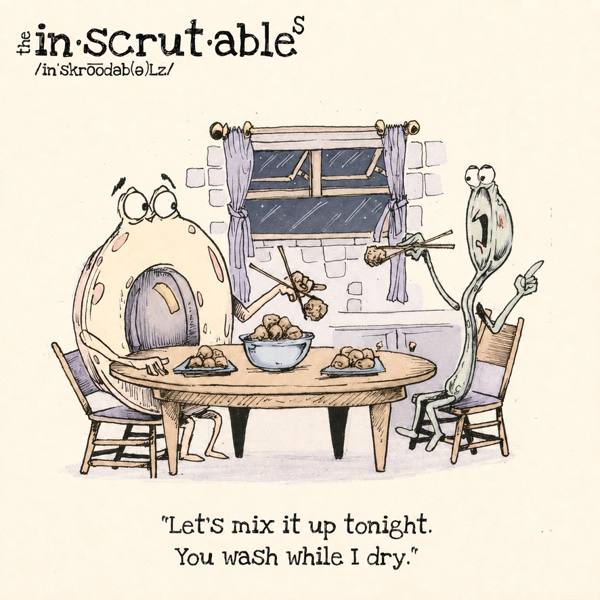
This revised paper argues that the comic panel under study is most fruitfully read not primarily as a surreal domestic scene featuring two unclassifiable beings, but as a knowingly distorted continuation of the nursery-rhyme universe of "Hey Diddle Diddle," in which "the dish ran away with the spoon." That allusion provides the panel's governing orientation: the characters are not merely odd creatures who happen to resemble tableware, but an established dish-and-spoon couple now encountered in the prosaic afterlife of romance, cohabitation, dinner, and cleanup.
This reframing clarifies several features at once. The couple's compatibility is inherited from literary precedent; their dinner-table intimacy is an extension of a canonical elopement; and the caption — "Let's mix it up tonight. You wash while I dry." — derives comic force from the contrast between fairy-tale pairing and the anticlimax of chore negotiation. The panel still contains a mild sexual undertone, insofar as "Let's mix it up tonight" initially implies erotic novelty before resolving into a proposal concerning dishwashing. But the primary joke is now better described as intertextual domestic deflation: the romantic glamour of legendary flight gives way, some years later, to household logistics.
To quantify the comic's remaining resistance to full explanation, the Institute retains the Single-Panel Inscrutability Index (SPII). With intertextual recognition incorporated into the scoring model, the panel's revised inscrutability score is 76.8/100: still highly inscrutable, though somewhat less ontologically opaque once the dish-and-spoon genealogy is acknowledged.
1. Introduction: After "Ran Away"
The decisive fact, previously underemphasized, is that the comic plainly invokes the nursery rhyme "Hey Diddle Diddle," whose best-known line announces that "the dish ran away with the spoon." What the panel offers, then, is not a random pairing of bizarre domestic entities, but a sequel.
This changes the interpretive center of gravity. The original version of the paper treated the panel's protagonists as biologically mysterious but socially legible. That remains partially true. Yet once the nursery-rhyme reference is restored to prominence, the mystery shifts from Who are these creatures? to What becomes of storybook elopers once their adventure matures into ordinary cohabitation?
The answer supplied by the panel is: they eat dinner, divide labor, and flirt in tones that are no longer fully distinguishable from chore management. This is, in its way, rather moving.
The comic derives force from the collapse of two temporal registers: the mythic past of the rhyme and the unglamorous present of domestic maintenance. A pair once defined by whimsical flight is now defined by questions of washing and drying. It is hard to imagine a more compact summary of adult life.
2. Intertextual Orientation as Primary Method
The relevant interpretive concept here is intertextuality: the way one text acquires meaning through its relation to another. The panel depends upon the reader's recognition that dish and spoon are not merely objects, but culturally pre-associated companions.
This recognition performs several analytical services. It explains why the figures appear together; why their being tableware is central rather than incidental; why the domestic setting is especially apt; and why the panel is less a surreal absurdity than a post-romantic continuation.
Under this reading, the comic asks a deliciously minor question: what happens after the dish runs away with the spoon? Not the moon, the fiddle, the cow, or the dog. The comic is not interested in the total ecology of the rhyme. It is interested in the labor implications of successful couple formation.
The answer is not "happily ever after." The answer is "somebody still has to do the dishes." This is the panel's masterstroke. It brings a famously whimsical union down to the level of sponge allocation.
3. The Caption and the Sexual Feint
The panel's dialogue includes a mild but unmistakable sexual undertone, and that feature remains worth addressing directly.
"Let's mix it up tonight." This phrase, especially in a private evening setting, briefly suggests erotic experimentation. It carries the syntax of a proposal to vary an established intimate routine. The follow-up sentence then converts that expectation into household procedure: "You wash while I dry."
Humor theory has long emphasized incongruity, especially the gap between anticipated and actual interpretation. Contemporary accounts such as McGraw and Warren's benign violation theory are also useful here: the panel lightly activates taboo-adjacent expectation and then resolves it harmlessly into soap, crockery, and role reversal.
Yet the allusion to Hey Diddle Diddle makes the effect sharper. The dish and spoon were, in the nursery-rhyme imagination, a quasi-romantic pair from the beginning. The comic therefore treats them as a long-married couple whose flirtation has survived — but in reduced and domesticated form. Their romance has not vanished. It has become administratively legible.
The joke, then, is not only that the reader expects sexual novelty and gets chores. It is that a pair once famous for running away together now locates novelty in switching positions at the sink. That is simultaneously comic, melancholy, and a decent definition of commitment.
4. From Fairy-Tale Pairing to Household Labor
Once the dish-and-spoon identification is foregrounded, the panel becomes a small essay on what follows enchantment.
Nursery rhymes tend to stop at the point of maximum image. The dish runs away with the spoon; no one asks about rent, schedules, or cleanup. The comic supplies what children's literature so often omits: continuity.
In that sense, the panel participates in a long comic tradition of demystification — taking something elevated, magical, or culturally overfamiliar and subjecting it to banal realism. Superheroes do laundry. Monsters queue for coffee. Legendary lovers discuss who took out the recycling. Here, legendary tableware eats dinner in a stone-walled kitchen and bargains over dish duty.
The brilliance of the premise lies in its self-reference. Because one of the characters is a dish and the other is a spoon, dishwashing is not merely a chore adjacent to their identity; it is identity-adjacent labor. The caption is funny partly because it turns the ontology of the characters into a maintenance problem. A spoon proposing that a dish wash while he dries is not the same as a lawyer proposing the same arrangement to a dentist. The joke is materially embedded.
5. Revised Inscrutability Methodology
The original paper proposed the Single-Panel Inscrutability Index (SPII) to measure the degree to which a comic remains strange even after its joke is understood. That framework remains serviceable, but the discovery — or, more accurately, the overdue admission — of the Hey Diddle Diddle reference requires recalibration.
| Variable | Score (0–10) |
|---|---|
| O — Ontological Uncertainty | 7.1 |
| C — Caption–Image Displacement | 7.8 |
| R — Residual Nonresolution | 7.4 |
| P — Pragmatic Polysemy | 8.6 |
| D — Domestic Norm Deflection | 8.9 |
| I — Intertextual Activation | 9.1 |
SPII-R = 10(0.20O + 0.15C + 0.15R + 0.15P + 0.15D + 0.20I) = 76.8 / 100
Why did the score decrease from the earlier 83.4? Because the panel is now less ontologically mysterious. The broad, rounded figure is best read as a dish; the thin, elongated one as a spoon. We are no longer confronting pure creaturely indeterminacy. Their bizarre bodies are part of the point, but they are anchored by literary identity.
At the same time, the new Intertextual Activation variable raises a different kind of complexity: the joke becomes richer because it depends on recognition of a prior text and on the deflation of that text's whimsical romance into chore realism.
Under the revised classification system, a score between 70 and 79.9 indicates: Intertextually Stabilized but Persistently Odd. That is the correct category for this panel. We know what they are. We still do not know, among other things, how exactly the dish sits down.
6. What the Allusion Explains — and What It Does Not
The allusion resolves why the characters are dish-like and spoon-like, why they are paired, why the domestic setting is narratively earned, and why the focus on washing and drying is apt. It does not fully explain the exact species status of anthropomorphic tableware, the mechanics by which a spoon eats meatballs, the stone-cottage setting, or why the dish seems faintly alarmed.
The comic remains strange — but now its strangeness is of a more specific kind. It is no longer arbitrary surrealism. It is nursery-rhyme realism.
7. Close Reading: Romance After Plot
The emotional intelligence of the panel lies in its compression of an entire relationship arc into one line.
The dish and spoon have already had their big narrative moment. They are not at the thrilling phase of escape; they are in the maintenance phase that follows. That does not trivialize romance. It relocates romance into negotiated reciprocity.
"Let's mix it up tonight" is funny because it treats routine as the condition under which novelty becomes perceptible. Switching who washes and who dries is framed as daring because the couple clearly operates by habit.
This also intensifies the sexual undertone. The misdirection works precisely because long-term couples often talk about intimacy and domestic logistics in the same rhetorical key: What if we did something different tonight? The panel's brilliance lies in allowing those domains briefly to overlap. The comic is not secretly about sex, nor merely about dishes. It is about the comedy of mature companionship, in which flirtation and labor share syntax.
8. Conclusion
This revised interpretation should be considered the authoritative one.
The panel is best understood as a post–Hey Diddle Diddle domestic sequel. The protagonists are the dish and the spoon, now living in the aftermath of their canonical escape. Their exchange stages the ordinary afterlife of legendary coupling.
Revised final score: SPII-R 76.8 / 100. Classification: Intertextually Stabilized but Persistently Odd.
Editorial recommendation: future versions of the paper should admit sooner that the dish is a dish and the spoon is a spoon.
Notes
- The line "the dish ran away with the spoon" is from the traditional English nursery rhyme "Hey Diddle Diddle," which has circulated in print at least since the eighteenth century. See Iona and Peter Opie, The Oxford Dictionary of Nursery Rhymes, 2nd ed. (Oxford: Oxford University Press, 1997), 213–214.
- For classic accounts of intertextuality, see Julia Kristeva, "Word, Dialogue and Novel," in The Kristeva Reader, ed. Toril Moi (New York: Columbia University Press, 1986), 34–61; and Graham Allen, Intertextuality, 2nd ed. (London: Routledge, 2011).
- John Morreall's overview of humor theory remains useful on incongruity; for benign violation, see A. Peter McGraw and Caleb Warren, "Benign Violations: Making Immoral Behavior Funny," Psychological Science 21, no. 8 (2010): 1141–1149.
- Thomas R. Shultz's work on incongruity and resolution in cartoon humor remains foundational here, even if he did not, regrettably, include anthropomorphic crockery. See Shultz, "The Role of Incongruity and Resolution in Children's Appreciation of Cartoon Humor," Journal of Experimental Child Psychology 13, no. 3 (1972): 456–477.
- The Institute notes that all numerical scales become more persuasive once expressed to one decimal place. This is not a scientific principle, but it has served several disciplines well.
- The reduction from 83.4 to 76.8 should not be interpreted as a decline in artistic quality. On the contrary, it reflects an increase in explanatory adequacy. The panel has become less mysterious only because the viewer has finally remembered a nursery rhyme most people learn before they can reliably tie their shoes.
References
Allen, Graham. Intertextuality. Routledge, 2000. — Kristeva, Julia. "Word, Dialogue and Novel." In Desire in Language. Columbia University Press, 1980. — McGraw, A. Peter, and Caleb Warren. "Benign Violations: Making Immoral Behavior Funny." Psychological Science 21, no. 8 (2010). — Shultz, Thomas R. "The Role of Incongruity and Resolution in Children's Appreciation of Cartoon Humor." Journal of Experimental Child Psychology 13 (1972). — Trope, Arthur. The Inscrutables. Comic panel, primary text.
Revision History
v1.0 — Original deposit; SPII 83.4, classification Highly Inscrutable but Domestically Functional; the dish and spoon treated as anatomically unclassifiable domestic partners. Superseded; preserved in the archive. v2.0 — Revised Edition (record of record); the Hey Diddle Diddle allusion restored as primary orientation, SPII-R recalibrated to 76.8. The editors regret the delay in admitting that the dish is a dish. Read the superseded original edition.
Citation
The Institute for Advanced Studies in Single Panel Comics. 2026. “You Wash While I Dry.” Working Paper Series, no. 43. Macguffin Co.
@techreport{iasspc_wp043,
  title       = {You Wash While I Dry},
  author      = {{The Institute for Advanced Studies in Single Panel Comics}},
  institution = {Macguffin Co.},
  type        = {Working Paper},
  number      = {43},
  year        = {2026},
  note        = {Archive record IASSPC-WP-043}
}