Working Paper No. 44
So You'd Like Us to Believe There Was a Duck
Anti-Humor, Willful Blindness, and the Forensic Afterlife of the Chicken-Crossing Joke
| Archive record | IASSPC-WP-044 |
|---|---|
| Primary comic | Arthur Trope, The Inscrutables — held in the Trope Collection |
| Series | Working Paper Series · Macguffin Co. · 2026 |
| Status | Deposited Version 1.0 |
Series Continuity Note. Working Paper No. 43 established that a panel depicting the dish and spoon from "Hey Diddle Diddle" becomes substantially more legible when treated as a sequel rather than a free-standing absurdity. No. 44 formalizes that observation as the Post-Canonical Afterlife Principle (PCAP) and standardizes the comparative SPII-2 framework for future papers.
Abstract
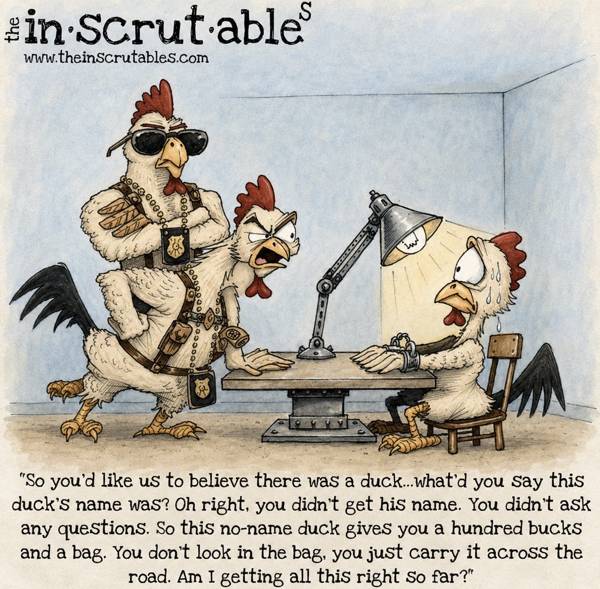
This paper examines an Inscrutables panel by Arthur Trope in which a visibly distressed chicken, handcuffed beneath an interrogation lamp, is questioned by two badge-bearing chickens concerning an encounter with an unidentified duck. According to the interrogator's reconstruction, the duck paid the suspect one hundred dollars, supplied a bag whose contents the suspect claims not to have inspected, and instructed him to carry it across the road. The panel's primary orientation is the canonical riddle "Why did the chicken cross the road?", whose familiar answer — "to get to the other side" — is one of the most durable examples of anti-humor in English-language popular culture. Its earliest widely documented print appearance dates to The Knickerbocker in 1847, where it was already presented as a pseudo-conundrum whose solution is aggressively obvious. Trope performs an inversion of that structure. Where the traditional joke produces humor through causal minimalism, this panel produces humor through causal overproduction. Applying the Institute's standardized Single-Panel Inscrutability Index, Version 2.0 (SPII-2), yields 73.6/100, classified as Intertextually Anchored, Causally Overdetermined. A supplementary measure introduced here, the Causal Inflation Ratio (CIR), records a sevenfold expansion of the canonical joke's causal burden. Comparison with Working Paper No. 43 further supports an emerging canon-wide principle: the Post-Canonical Afterlife Principle (PCAP), by which familiar jokes and rhymes continue beyond the point at which collective memory normally abandons them.
1. The Comic Begins Where the Joke Ends
The traditional chicken joke asks a question: Why did the chicken cross the road? Its canonical answer is radically unambitious: To get to the other side.
The joke works because the form announces a riddle while the answer refuses to behave like one. The listener anticipates ingenuity, wordplay, or hidden causation and instead receives the ordinary purpose of crossing almost anything. The USC Digital Folklore Archives describes the form as an anti-joke: a setup that invites a conventional punch line and then supplies a literal, mundane answer.
Trope's panel does something structurally opposite. It takes the question seriously. Not merely seriously, in fact, but institutionally.
The road-crossing has occurred. We do not see it. No road appears in the drawing at all. The canonical event exists only retrospectively, as an incident now being reconstructed under interrogation. This absence is crucial. The familiar joke normally ends at the far curb.
The Inscrutables' temporal move. Canonical joke: Why did the chicken cross the road? → To get to the other side. Trope's continuation: Fine. Now explain the duck, the hundred dollars, and the bag. Trope begins where the joke stops.
2. From Riddle to Police Procedural
Visually, the panel replaces the abstract space of a joke with the highly coded space of an interrogation room. A chicken sits sweating at a table, one wrist restrained. An articulated lamp directs light toward him with considerably more intensity than is normally required for poultry. Opposite him, another chicken leans forward in accusation. Behind that interrogator stands a larger bird wearing dark glasses, crossed arms, visible badges and enough leather accessories to suggest that several departmental budgets have recently been approved.
We have moved from conundrum to procedural.
The caption consists almost entirely of the interrogator restating the suspect's story: an unidentified duck, a hundred-dollar payment, a bag whose contents were allegedly never inspected, and a request to carry that bag across the road. What has happened to the simplest joke in the English-speaking world? It has acquired a case file.
Incongruity theory remains useful here. The dominant contemporary account treats humor as arising when an event violates ordinary mental patterns or expectations. The traditional chicken joke frustrates the expectation that a riddle should reward interpretive labor. Trope frustrates a different expectation: that a culturally exhausted non-mystery cannot possibly support a full criminal investigation.
3. The Causal Inflation Ratio
To quantify this transformation, the Institute introduces the Causal Inflation Ratio (CIR).
The baseline joke contains one motive-bearing proposition — B1: the chicken crosses the road because it wishes to reach the other side. The comic supplies at least seven evidentiary propositions:
- There was a duck.
- The chicken did not obtain the duck's name.
- The chicken asked no questions.
- The duck supplied one hundred dollars.
- The duck supplied a bag.
- The chicken claims not to have inspected the bag.
- The chicken transported the bag across the road.
CIR = T/B = 7/1 = 7.0×
The canonical joke minimizes cause. The comic multiplies it until the crossing resembles the last operational step in a conspiracy. This should not be mistaken for an accepted method in folklore studies, criminology, statistics, or any discipline with an accreditation process. Its usefulness is nevertheless obvious. The canonical joke is funny because nothing interesting explains the crossing. Trope's joke is funny because far too much explains it.
We therefore propose the term causal overdetermination humor: a familiar event whose traditional comedy depends upon lack of explanation is reconstructed using an absurd surplus of explanation.
4. The Anti-Joke Is Put Under Oath
The history of the chicken joke makes this inversion particularly elegant. In its 1847 Knickerbocker appearance, the editor introduces it among supposed conundrums that are not really conundrums at all before asking why a chicken crosses the street and answering that it wants to get to the other side. In other words, the joke was already functioning as a joke about the failure of riddle logic.
Its descendants preserve this architecture precisely because the expected answer is culturally overlearned. Salomon and Singer even used the chicken-crossing question as the title of a scholarly article on transportation cartoons, treating cartoon humor as a medium through which social experience and policy are interpreted.
Trope does not merely substitute another punch line. He criminalizes the premise. The question Why did the chicken cross the road? becomes no longer a comedian's invitation but an investigator's demand. The chicken has finally encountered somebody unwilling to accept "To get to the other side."
5. Ignorance as Evidence
The interrogation's funniest linguistic maneuver concerns what the chicken claims not to know. He does not know the duck's name. He did not ask questions. He did not inspect the bag.
Ordinarily, ignorance might appear exculpatory. The interrogator converts it into suspicion.
This resembles, without necessarily satisfying, the legal logic of willful blindness. In Global-Tech Appliances, Inc. v. SEB S.A., the U.S. Supreme Court described the doctrine as requiring a subjective belief in a high probability that a fact exists plus deliberate actions to avoid learning that fact. The comic does not provide enough evidence for the Institute to determine the chicken's liability, and the Institute is not admitted to practice law in any jurisdiction, including poultry court.
But rhetorically the resemblance is exact. The suspect says: I didn't know. The interrogator hears: You made sure you didn't know. "Didn't get his name," "didn't ask any questions," and "didn't look in the bag" are arranged not as three absences but as three affirmative failures of curiosity. The chicken's defense is thus being converted, sentence by sentence, into the prosecution's theory.
6. The Chicken Becomes a Mule
The animal taxonomy contains an additional joke that the panel never needs to state. Functionally, the chicken is being accused of behaving as a mule.
Law-enforcement terminology uses money mule for a person who transfers or moves illegally acquired money on behalf of another; some money mules knowingly support criminal enterprises while others are unaware of the criminal origin or purpose of the funds. Trope gives us the physical-cargo analogue: unknown principal → payment → unexplained package → transportation → plausible deniability.
Except the mule is a chicken. The principal is a duck. The Institute believes comparative animal criminology has now reached its natural limit.
7. The Duck as Absent Cause
The duck never appears. This makes him the most powerful character in the panel.
Everything depends upon his alleged existence, yet he is available only through the suspect's testimony. The interrogator repeats "duck" skeptically, demands a name, and then upgrades him rhetorically to the splendid phrase "this no-name duck." The construction already sounds prosecutorial.
The duck functions as an absent cause: an unseen figure whose supposed actions explain the entire visible situation. He has supplied money, cargo, motive and possibly criminal jeopardy while avoiding the inconvenience of being drawn.
His species also contributes a small phonetic reward: duck / bucks. A hundred bucks from a duck is not enough to turn the panel into a pun, but it provides just enough nursery-level sonic play to keep the adult criminal scenario tethered to the childhood joke beneath it. This tonal collision is central to The Inscrutables: childish cultural material is not destroyed but subjected to adult institutions.
8. A Finding from the Emerging Canon
Working Paper No. 43 argued that the dish-and-spoon panel should be understood as a continuation of Hey Diddle Diddle. Its central question was effectively: What happened after the dish ran away with the spoon? Answer: they apparently settled down together and developed fixed dishwashing roles.
The present panel asks: What happened after the chicken crossed the road? Answer: he was detained.
Two examples do not constitute an iron law of cartoon production, except at this Institute, where they constitute enough evidence for a named principle.
Post-Canonical Afterlife Principle (PCAP). An Inscrutables panel may derive its comic premise by extending a culturally familiar joke, rhyme, phrase, or narrative beyond the terminal moment at which popular memory conventionally abandons it.
The joke or rhyme supplies the past. Trope supplies the consequences. The dish and spoon discover marriage. The chicken discovers questioning without counsel. This is not mere parody. It is continuity management for folklore.
9. SPII-2: Standardized Inscrutability Measurement
Working Paper No. 43 demonstrated that panel-specific categories make longitudinal comparison difficult. Beginning with the present paper, the Institute therefore standardizes the SPII-2 around six reusable dimensions.
| Variable | Dimension | Score |
|---|---|---|
| O | Ontological Uncertainty | 1.5 |
| C | Caption–Image Displacement | 6.0 |
| R | Residual Nonresolution | 7.8 |
| P | Pragmatic Polysemy | 8.9 |
| I | Intertextual Dependency | 9.8 |
| N | Narrative Excess | 9.2 |
SPII-2 = 10(0.15O + 0.15C + 0.20R + 0.15P + 0.20I + 0.15N) = 73.6 / 100. Classification: Intertextually Anchored, Causally Overdetermined.
The relatively low Ontological Uncertainty score reflects the unusual clarity of the cast. These are chickens. Whatever else The Inscrutables may demand of us, zoological identification is not the primary burden here. The extremely high Intertextual Dependency reflects the fact that the road crossing becomes substantially funnier once the canonical joke is recognized. Narrative Excess is also unusually high: the original six-word answer has metastasized into a duck, cash payment, unidentified cargo, custodial interrogation and a possible poultry-trafficking investigation.
10. Conclusion
The genius of this panel lies in treating one of the least complicated explanations in joke history as though it were obviously a lie. For nearly two centuries, the chicken has been crossing the road simply to reach the other side. Arthur Trope finally asks to see the receipts.
The panel replaces anti-humor's famous shortage of causation with an extravagant causal chain: an anonymous duck, one hundred dollars, an unopened bag and a suspiciously incurious courier. The interrogator's mounting disbelief transforms a harmless crossing into evidence of something much larger, while the viewer never learns what was actually in the bag.
This unresolved detail matters. The comic does not answer the old question. It makes the old question indictable.
More broadly, comparison with Working Paper No. 43 suggests that The Inscrutables repeatedly operates in the afterlife of familiar culture. Trope takes moments that normally end a rhyme or joke and allows time to continue. The dish ran away with the spoon. Then they had to wash up. The chicken crossed the road. Then Internal Affairs called.
Further research is strongly recommended, particularly for the duck.
Final SPII-2: 73.6 / 100 · CIR: 7.0× · Investigative recommendation: do not answer further questions until counsel arrives.
Notes
- The Knickerbocker; or, New-York Monthly Magazine, vol. 29 (March 1847), p. 283. The USC Digital Folklore Archives identifies this issue and page as the earliest known printed form and classifies the joke as anti-humor.
- John Morreall, "Philosophy of Humor," Stanford Encyclopedia of Philosophy, substantive revision Sept. 19, 2024, on incongruity as violation of standard mental patterns and expectations.
- For a searchable secondary transcription of the 1847 passage, see Barry Popik, "Why did the chicken cross the road? (joke)."
- Ilan Salomon and Rachel Singer, "Why did the chicken cross the road, and what's funny about it? The role of transportation cartoons in social experiences," Transport Policy 18, no. 1 (2011): 1–12.
- Global-Tech Appliances, Inc. v. SEB S.A., 563 U.S. 754 (2011).
- Federal Bureau of Investigation, "Money Mules," describing knowing and unknowing participants.
- SPII-2 is an Institute-created instrument with no empirical validation, inter-rater reliability study, normative sample, ethics-board approval, or evident reason to exist beyond the requirements of this publication program. These deficiencies will be addressed in future research by changing the version number.
References
Federal Bureau of Investigation. "Money Mules." — Global-Tech Appliances, Inc. v. SEB S.A., 563 U.S. 754 (2011). — The Knickerbocker; or, New-York Monthly Magazine. Vol. 29, March 1847, p. 283. — Morreall, John. "Philosophy of Humor." Stanford Encyclopedia of Philosophy, rev. 2024. — Popik, Barry. "Why did the chicken cross the road? (joke)." — Salomon, Ilan, and Rachel Singer. "Why did the chicken cross the road, and what's funny about it?" Transport Policy 18, no. 1 (2011): 1–12. — The Institute for Advanced Studies in Single Panel Comics. Working Paper No. 43. Macguffin Co., 2026. — Trope, Arthur. The Inscrutables. Comic panel reproduced as Primary Specimen 44-A.
Revision History
v1.0 — Original deposit. Standardizes SPII-2 for the series and formalizes the Post-Canonical Afterlife Principle.
Related Institute Research
Citation
The Institute for Advanced Studies in Single Panel Comics. 2026. “So You'd Like Us to Believe There Was a Duck.” Working Paper Series, no. 44. Macguffin Co.
@techreport{iasspc_wp044,
  title       = {So You'd Like Us to Believe There Was a Duck},
  author      = {{The Institute for Advanced Studies in Single Panel Comics}},
  institution = {Macguffin Co.},
  type        = {Working Paper},
  number      = {44},
  year        = {2026},
  note        = {Archive record IASSPC-WP-044}
}