Working Paper No. 45
Our Last Village Idiot Was Promoted to Town Buffoon
Precarious Labor, Comic Hierarchy, and Upward Mobility in the Inscrutables Canon
| Archive record | IASSPC-WP-045 |
|---|---|
| Primary comic | Arthur Trope, The Inscrutables — held in the Trope Collection |
| Series | Working Paper Series · Macguffin Co. · 2026 |
| Status | Deposited Version 1.0 |
Abstract
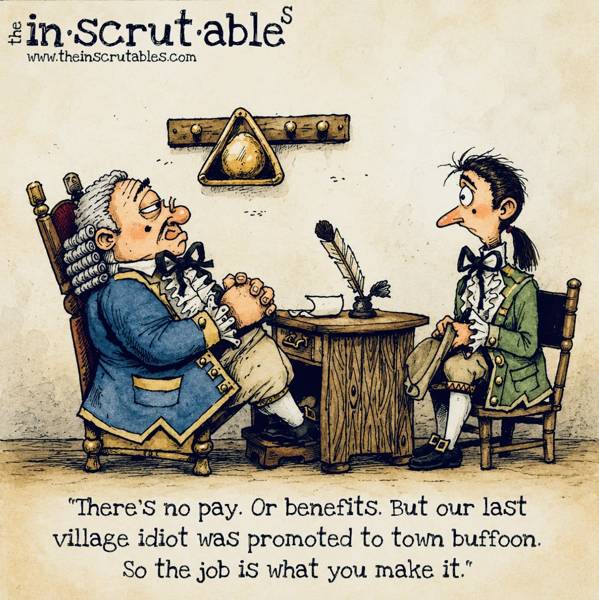
This paper examines an Inscrutables panel by Arthur Trope depicting what appears to be a job interview in a vaguely premodern village or municipal setting. An imposing official informs a nervous candidate: "There's no pay. Or benefits. But our last village idiot was promoted to town buffoon. So the job is what you make it." The comic's humor derives from a dense convergence of employment rhetoric, social hierarchy, and institutional absurdity. It borrows the familiar language of modern labor markets — promotion, compensation, benefits, self-making — and applies it to an office that should not exist as a formal position: village idiot.
The panel is best understood as a satire of precarious work disguised as opportunity. The speaker offers no wage, no benefits, and no dignity, yet attempts to frame the position as an attractive growth path through the promise of advancement to a marginally more prestigious form of public foolishness. The phrase "the job is what you make it", conventionally used to dignify undercompensated work by recoding structural deprivation as personal possibility, becomes especially sharp when applied to hereditary or civic stupidity.
Using the Institute's standardized Single-Panel Inscrutability Index, Version 2.0 (SPII-2), the comic receives a score of 68.9/100, classified as Socially Legible, Institutionally Absurd. A supplementary measure introduced here, the Buffoon Mobility Coefficient (BMC), quantifies the panel's satirical inflation of career progression in nonviable labor systems. The BMC score of 8.7/10 reflects the extraordinary confidence with which a nonexistent compensation package is replaced by a fictional ladder of comic advancement.
This paper also extends a finding from Working Papers No. 43 and No. 44: The Inscrutables repeatedly transforms familiar cultural material by asking what happens when its underlying premise is administered by institutions. There, folklore and anti-joke logic survived into marriage and police procedure. Here, insult terminology survives into human resources.
1. Introduction: When Derogation Becomes a Career Track
The panel under study presents a scene of recruitment. A seated elder or magistrate-like figure interviews a younger applicant across a small desk. The visual coding suggests authority: powdered wig, formal coat, relaxed posture, and a decorous interior. The applicant, by contrast, appears underprepared, anxious, and only dimly aware that the interview has already gone badly.
The speaker's line is devastating: "There's no pay. Or benefits. But our last village idiot was promoted to town buffoon. So the job is what you make it."
The joke depends first on a categorical violation. Village idiot is ordinarily not a job title. It is a social insult, a folk type, or a term for a person treated as the designated fool of a local community. Town buffoon, meanwhile, is only marginally more formal. The comic's central move is to bureaucratize these categories and then place them inside the language of professional advancement.
This is the panel's great innovation: it imagines a world in which ridicule has been fully incorporated into administrative structure. The candidate is not being insulted spontaneously. He is being onboarded.
2. From Folk Type to Organizational Chart
The phrase village idiot has deep cultural roots as a stock figure: the local fool whose function is less individual than communal. Like the court fool, the simpleton, or the town drunk, the village idiot historically belongs to the repertory of recognizable social roles through which a community narrates itself. Such figures often carry contempt, affection, entertainment value, and disciplinary force at once.
Buffoon likewise denotes a comic fool, but with a different texture. A buffoon is not merely unintelligent; he is publicly ridiculous, performative, and socially visible. The semantic distinction is crucial to the joke. The panel therefore implies an occupational ladder: village idiot — local, low-status, perhaps passive; town buffoon — more expansive, more public, perhaps more theatrical. In other words, the speaker presents the advancement not from incompetence to competence, but from localized foolishness to municipal-scale clowning.
This is absurd, but not arbitrary. Modern workplaces frequently dignify miserable or underpaid labor by emphasizing "growth," "trajectory," "opportunity," or "exposure" in place of material compensation. The panel satirizes this exact rhetorical substitution. The humor emerges when the ladder itself is morally and intellectually worthless. One is not being offered a career. One is being offered a larger jurisdiction of humiliation.
3. The Labor-Market Satire
The line "There's no pay. Or benefits." immediately situates the joke inside the rhetoric of labor precarity.
This opening matters because it sounds unmistakably contemporary. However antique the costumes may be, the language evokes present-day exploitative hiring: unpaid internships, badly compensated "opportunities," start-up evangelism, mission-driven underpayment, and all the familiar moral theater by which employers attempt to alchemize extraction into aspiration.
The follow-up line — "But our last village idiot was promoted to town buffoon" — performs the classic managerial pivot from deficiency to upside. Lack of compensation is reframed as a tradeoff for advancement. The final clause, "So the job is what you make it," completes the maneuver by transferring responsibility for the position's value from institution to individual.
This is a recognizable ideological move. Rather than ask whether the job is any good, the candidate is invited to prove himself by endowing it with meaning. The panel's satire is therefore not merely about foolishness. It is about the language used to justify bad jobs. Indeed, the line is so plausible that, outside the comic, one can imagine it being delivered by a hiring manager who believes it to be encouraging. That possibility deepens the joke.
4. Institutionalizing the Fool
A major source of humor lies in the mismatch between the office's supposed formality and its underlying content.
The room suggests procedure. There is furniture, a writing surface, posture, sequence, decorum. The speaker appears to occupy some civic or aristocratic authority. The panel thus asks us to imagine a village or town with enough institutional maturity to have: a hiring process, a vacant fool position, a historical record of prior occupancy, and a promotion pathway. The job has apparently existed long enough to produce precedent.
The phrase "our last village idiot" is especially important. It suggests continuity, succession, and organizational memory. This is not an improvised insult directed at an unlucky passerby. It is a role the institution expects to fill on an ongoing basis. The comic thereby discovers a wonderful bureaucratic absurdity: stupidity has become a renewable civic resource.
5. The Buffoon Mobility Coefficient (BMC)
To quantify the panel's treatment of opportunity rhetoric, the Institute introduces the Buffoon Mobility Coefficient (BMC). This supplemental metric estimates the degree to which a comic transforms a patently undesirable or exploitative role into an allegedly aspirational one through fictive mobility. Five variables, each scored from 0 to 2:
| Variable | Description | Score |
|---|---|---|
| U | Uncompensated labor framing | 2.0 |
| P | Presence of a nominal promotion path | 2.0 |
| R | Rhetorical substitution of meaning for compensation | 2.0 |
| H | Hierarchical absurdity of the promotion itself | 1.9 |
| C | Confidence with which the authority figure sells the proposition | 0.8 |
BMC = U + P + R + H + C = 8.7 / 10
The slightly reduced confidence score reflects an important nuance: the interviewer seems confident enough, but his confidence also carries the tiredness of a man who has had to fill this vacancy before.
The BMC is high because the comic offers a nearly pure specimen of false upward mobility. Not only is there no pay or benefits, but the touted promotion does not redeem the office. Town buffoon is merely a wider radius of indignity. Thus the panel satirizes a particularly modern phenomenon: the job whose primary benefit is the possibility of a more impressive-sounding version of the same exploitation.
6. SPII-2 Assessment
| Variable | Dimension | Score |
|---|---|---|
| O | Ontological Uncertainty | 0.9 |
| C | Caption–Image Displacement | 6.8 |
| R | Residual Nonresolution | 6.7 |
| P | Pragmatic Polysemy | 8.1 |
| I | Intertextual Dependency | 5.9 |
| N | Narrative Excess | 8.4 |
SPII-2 = 10(0.15O + 0.15C + 0.20R + 0.15P + 0.20I + 0.15N) = 68.9 / 100. Classification: Socially Legible, Institutionally Absurd.
The low Ontological Uncertainty score distinguishes this panel from Working Paper No. 43. There, the difficulty began with identifying what the characters actually were. Here, the figures are recognizably human. The strangeness lies not in their bodies but in their social world.
Caption–Image Displacement is moderately high because the caption gives us a labor-market premise while the picture implies a quasi-historical civic apparatus. Narrative Excess is strong because the line quietly implies an entire administrative structure beneath the joke: job vacancies, rankings of foolishness, prior appointments, and a village-to-town jurisdictional distinction.
Most importantly, Pragmatic Polysemy is high. The line can be read simultaneously as an employment joke, a satire of precarity, a joke about class and dignity, a parody of upward mobility, and an institutionalization of insult. It is doing quite a lot for one sentence, especially considering that most of the sentence is bad news.
7. Relation to the Emerging Canon
Working Papers No. 43 and No. 44 established the Post-Canonical Afterlife Principle (PCAP): the idea that The Inscrutables often begins where familiar stories or jokes conventionally stop. The dish and spoon, having run away, must now divide domestic labor. Working Paper No. 44 showed the same pattern in procedural form: after the chicken crosses the road, the state becomes interested.
The present panel extends the logic, though in a slightly different register. Here, the comic does not continue a single nursery rhyme or anti-joke so much as formalize a stock social category. The village idiot — normally a figure of folklore, insult, or village anecdote — is inserted into institutional procedure. In this sense, the panel belongs to a related but distinct canon pattern:
Bureaucratic Reification of Folk Types (BRFT). An Inscrutables panel derives humor by treating an informal cultural type, saying, or social fiction as though it were governed by official procedure, hierarchy, and administrative continuity.
Under BRFT: the fool gets a job title, the insult gets a promotion ladder, and mockery gets human resources. This is useful for the series because it gives us a second recurring framework beside PCAP. Some panels ask what happens after the cultural artifact. Others ask what happens when the cultural artifact acquires paperwork.
8. Why the Joke Lands So Hard
The panel is funny not just because "village idiot" is a ridiculous position, but because the interviewer's rhetoric is so familiar. Readers have heard versions of this pitch before: there's no pay, but it's good experience; there are no benefits, but there's room to grow; the role is challenging, but it's what you make it; the title now may be poor, but it could lead to something later.
Trope's genius is to remove all camouflage. By making the role itself ludicrous, he exposes the structure of the pitch.
The comic also understands the cruel optimism of advancement. The candidate is invited to accept present degradation in exchange for future distinction, but the future distinction remains continuous with the degradation itself. Promotion does not free him from being a fool; it simply scales the office upward. That is almost too accurate a description of modern labor.
9. Conclusion
This panel should be regarded as one of the canon's clearest expressions of institutional satire. Its premise is simple but devastating: a community has formalized the role of village idiot, offers it without compensation, and markets it through the possibility of eventual promotion to town buffoon. In so doing, the comic fuses folk hierarchy, labor precarity, managerial euphemism, and civic absurdity into a single elegant line.
Unlike more ontologically puzzling Inscrutables entries, this one is visually and socially legible. We understand the scene. What unsettles us is the degree to which the scene resembles real systems of recruitment, prestige, and exploitation.
The interviewer's final reassurance — "the job is what you make it" — is the line that transforms absurdity into satire. It is the language of self-making turned against a structural void. There is no pay, no benefits, and no dignity, but one is free to excel.
SPII-2: 68.9 / 100 · BMC: 8.7 / 10 · Human-resources recommendation: decline the offer unless the buffoon track vests immediately.
Notes
- On the stock figure of the fool, idiot, and simpleton in cultural history, see, among many others, Sandra Billington, A Social History of the Fool (New York: St. Martin's Press, 1984). The present paper uses such categories descriptively and analytically, not normatively.
- The distinction between fool, clown, jester, and buffoon is historically fluid. See Beatrice K. Otto, Fools Are Everywhere: The Court Jester Around the World (Chicago: University of Chicago Press, 2001). The panel's humor depends precisely on exploiting that fluidity as though it were a clear civil-service ranking.
- The rhetoric of compensating poor work conditions with promises of self-realization has been extensively discussed in sociological and labor writing. See Kathi Weeks, The Problem with Work (Durham: Duke University Press, 2011), especially on the moralization of work as a site of identity and meaning.
- The phrase "the job is what you make it" belongs to a broad family of managerial encouragements that shift the burden of meaning from employer to employee. The Institute notes that this phrase becomes noticeably less inspiring when the office in question is village idiot.
- Working Paper No. 44 introduced the Post-Canonical Afterlife Principle (PCAP). The current paper proposes Bureaucratic Reification of Folk Types (BRFT) as a complementary canon principle.
- The Buffoon Mobility Coefficient has not been validated in any serious field and is unlikely to be. It nevertheless captures a real comic phenomenon: the inflation of bad positions through a theatrically optimistic advancement structure.
- The Institute emphasizes that "town buffoon" may in some villages be regarded as an honored office. We have found no evidence of this, but methodological neutrality requires that we acknowledge the possibility.
References
Billington, Sandra. A Social History of the Fool. New York: St. Martin's Press, 1984. — Otto, Beatrice K. Fools Are Everywhere: The Court Jester Around the World. Chicago: University of Chicago Press, 2001. — Weeks, Kathi. The Problem with Work. Durham: Duke University Press, 2011. — The Institute for Advanced Studies in Single Panel Comics. Working Papers Nos. 43–44. Macguffin Co., 2026. — Trope, Arthur. The Inscrutables. Comic panel, primary text.
Revision History
v1.0 — Original deposit. Proposes Bureaucratic Reification of Folk Types (BRFT). One attribution harmonized at deposit: the paper's §7 now credits PCAP's formalization to WP44, matching its own note 5; the Registrar regrets the original discrepancy.
Related Institute Research
Citation
The Institute for Advanced Studies in Single Panel Comics. 2026. “Our Last Village Idiot Was Promoted to Town Buffoon.” Working Paper Series, no. 45. Macguffin Co.
@techreport{iasspc_wp045,
  title       = {Our Last Village Idiot Was Promoted to Town Buffoon},
  author      = {{The Institute for Advanced Studies in Single Panel Comics}},
  institution = {Macguffin Co.},
  type        = {Working Paper},
  number      = {45},
  year        = {2026},
  note        = {Archive record IASSPC-WP-045}
}