Working Paper No. 50
Schrödinger's Mice May or May Not Have Something to Do with It
Quantum Indeterminacy, Hidden Agency, and Rodent Complicity in the Inscrutables Canon
| Archive record | IASSPC-WP-050 |
|---|---|
| Primary comic | Arthur Trope, The Inscrutables — held in the Trope Collection |
| Series | Working Paper Series · Macguffin Co. · 2026 |
| Status | Deposited Version 1.0 |
Abstract
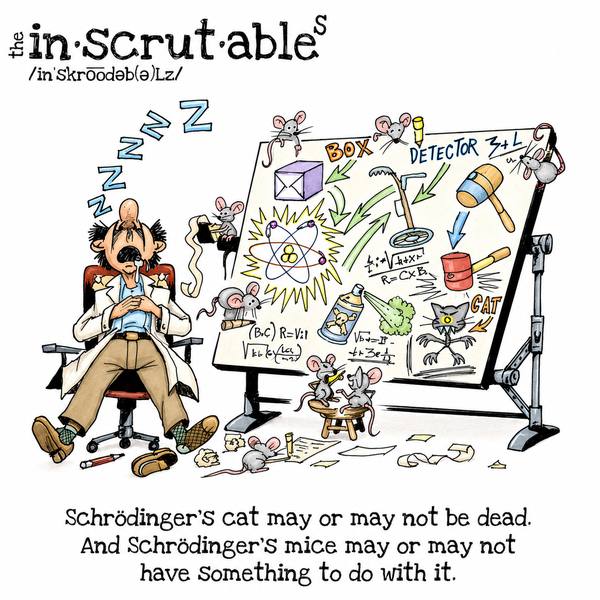
This paper examines an Inscrutables panel in which a sleeping Schrödinger is surrounded by industrious mice who appear to be engineering the famous cat thought experiment from behind the scenes. The comic converts quantum indeterminacy into backstage rodent labor. By showing mice planning around a whiteboard labeled box, detector, and cat, the panel reassigns causal agency from the physicist and the abstract apparatus to overlooked secondary actors. The joke depends on the viewer's familiarity with Schrödinger's cat, but it also functions as a satire of scientific authorship, invisible technical labor, and the tendency of explanatory systems to conceal the workers who actually make them run. The paper introduces the Quantum Complicity Index (QCI) and reports a score of 9.2/10, alongside an SPII-2 score of 81.7/100. On these measures, the panel ranks high in hidden agency and scholarly punch. We conclude that Trope's comic is best understood as a study in hidden agency, delegated causality, and institutional sleep.
1. Introduction: The Cat Was Never Alone
Erwin Schrödinger introduced the cat thought experiment in 1935 as a critique of naïve interpretations of quantum superposition. He used the device to dramatize how, within the formalism, a system can inhabit incompatible states until an observation yields a result. Trope's panel does not merely quote that famous scenario; it sneaks behind it. A sleeping Schrödinger sits oblivious while mice sketch an operational plan involving a box, detector, hammer, and cat. The comic asks not whether the cat is alive or dead, but who has been arranging the conditions under which that question becomes meaningful.
In this inversion, the panel humanizes — or rather rodentizes — the apparatus. The classic thought experiment imagines a sealed system and an observer outside it; this cartoon introduces a third category: hidden agents busily preparing the experiment while the nominal author sleeps through his own legend. The mice confer, annotate equations, assign tasks, and test instruments. They turn abstraction into procedure, transforming philosophical provocation into practical logistics. The caption's "may or may not" rhythm cleverly echoes superposition while withholding certainty about the mice's guilt.
Trope's comic belongs to the broader Inscrutables tendency to revisit cultural commonplaces by exposing the bureaucratic, domestic, or backstage machinery behind them.
2. Delegated Causality and Rodent Labor
The panel's funniest move is the transfer of agency from the canonical physicist to a covert workforce of mice. Schrödinger sleeps — mouth open, tie loose, posture slack — while the mice are awake, coordinated, and apparently in charge. The joke is not merely that the author has anthropomorphized animals, it is that the hierarchy of intellect and action has been inverted. The celebrated theorist, whose name sanctifies the thought experiment, is inert. The real work is performed by a distributed team of rodents.
In that inversion lies a pointed critique. The history of science is popularly narrated through great individuals, as if discovery were the solitary product of genius. Yet the practice of science is irreducibly collective. What appears as a moment of inspiration is usually the sediment of many hands: assistants who build and align, technicians who calibrate, students who test, administrators who fund and file, and instruments that extend human capacity. The comic condenses that reality into farce: a rodent crew appears to be managing the lethal infrastructure while the celebrity theorist naps.
The mice are not merely decorative. They occupy strategic positions on and around the whiteboard, on the floor, and atop apparatus. Some draft, some point, some haul or strike, some consult. Their placement suggests a division of labor and a plan in progress. One reads, in their arrows and annotations, planning; in their tools and materials, implementation; in their bustle, coordination across roles. In short, they look like a project team. By sleeping through it, Schrödinger becomes the figurehead rather than the worker. Ideas get signed. Credit accrues to names. Meanwhile, the machinery of knowing is assembled, maintained, and operated by others, often unacknowledged. The panel satirizes that economy of recognition by placing the architect of indeterminacy in the posture of passivity while his mice carry out the precise, risky, and consequential tasks that make the thought experiment imaginable.
3. The Whiteboard as Forensic Evidence
If the mice are the agents, the whiteboard is the panel's evidentiary center. It is crowded with labeled elements — box, detector, arrows, formulas, mallet or hammer, atom-like diagram, and the sketched cat — interconnected in a web of signs. Read as a whole, it functions less like a clean theorem and more like a crime-scene diagram. Each item marks a step or component in a chain. Arrows indicate sequence and causation. Equations appear as operational rules. The board externalizes what is normally hidden inside the famous thought experiment: mechanism, sequence, and intent. The panel therefore shifts the register of the story. What is often presented as a metaphysical puzzle — superposition, indeterminacy — becomes, here, a procedural apparatus with practical means and foreseeable outcomes. The comedy arises from that demystification.
The absence of color in the board's drawings contributes to the mock-technical seriousness. Black ink on white ground mimics the austerity of laboratory sketches and lecture diagrams. It makes the mice look less like chaotic vandals and more like careful planners. At the same time, the semi-legibility of the notation — authentic in appearance yet not wholly decipherable — creates a productive tension between apparent precision and actual ambiguity. One cannot verify the math, but one trusts the posture of method. The result is that the viewer becomes a reluctant investigator, reading traces of a conspiracy that may or may not exist.
4. Methodology: The Quantum Complicity Index (QCI)
To quantify the extent to which hidden agents plausibly influence a famous paradox while remaining epistemically deniable, we propose the Quantum Complicity Index (QCI), a whimsically serious metric anchored in plausibility, opacity, and plausible innocence. Each factor is scored on a scale from 0 (not at all) to 2 (very much so). The index rewards panels that make hidden involvement feel both disturbingly likely and comfortably unprovable. Weights reflect theoretical elegance rather than empirical rigor.
| Factor | Score (0–2) |
|---|---|
| Canonical recognizability | 1.9 |
| Hidden agency salience | 2.0 |
| Apparatus legibility | 1.7 |
| Motivational opacity | 1.8 |
| Indeterminacy preservation | 1.8 |
QCI = sum of weighted factors = 9.2 / 10
The resulting score is high because the mice are everywhere visible and operationally indispensable to the theory-in-progress; their complicity is not hidden in the shadows of the panel but performed in plain sight. Yet the apparatus of accusation remains delightfully open-ended: the mice might be conducting the experiments, misreading the data, sabotage-testing the hypothesis, or simply cleaning up after an unusually disorganized physicist. The visual logic is compelling without being conclusive, preserving just enough uncertainty to ensure that the accusation stays playful rather than prosecutorial.
5. SPII-2 Assessment
We now evaluate the panel using the Standard Single-Panel Inscrutability Index, Version 2.0 (SPII-2). This index measures how effectively a panel sustains interpretive density, semantic slippage, and ontological unease while resisting total resolution. Each category is scored on a scale from 0 (not at all) to 10 (maximally inscrutable).
| Category | Score (0–10) |
|---|---|
| Ontological Uncertainty | 1.5 |
| Caption–Image Displacement | 8.6 |
| Residual Nonresolution | 8.7 |
| Pragmatic Polysemy | 8.9 |
| Intertextual Dependency | 9.4 |
| Narrative Excess | 7.3 |
SPII-2 = 81.7 / 100. Classification: Intertextually Anchored, Mechanistically Overexplained, Ontologically Mischievous.
The panel remains highly inscrutable because the viewer understands the joke immediately yet cannot fully decide whether the mice are causal agents, commentators, opportunists, or merely exceptionally organized bystanders. The apparent explanation multiplies rather than cancels interpretations, ensuring that the mystery is enhanced by every explanatory detail.
6. Canon Placement: Backstage Causal Reassignment
We introduce a new canon principle: Backstage Causal Reassignment (BCR). BCR holds that an Inscrutables panel derives humor by transferring responsibility for a well-known event, paradox, or cultural artifact from its canonical author or visible protagonists to previously unseen support actors.
How does this panel compare to earlier findings? The dish and spoon panel extended a nursery rhyme into domestic routine; the chicken-crossing panel turned a joke into an interrogation; the alligator periodontist panel exposed taxonomic bias in professional trust. Each worked by reassigning the explanatory center of a familiar situation to an unexpected agent.
The Schrödinger panel belongs to the same family of after-the-fact explanatory comedy, but with a distinctive emphasis on hidden labor and authorship. Here, responsibility for the paradox of superposition — traditionally attributed to a lone physicist and his abstracted apparatus — is reassigned to a small team whose work makes the paradox possible. The mice do not merely witness the experiment; they administer it, maintain it, record it, and likely invented the acronym. That their contributions are entirely absent from the canonical narrative is the joke.
BCR is especially useful when the cartoon's comedy emerges from assigning backstage operations to subordinate figures — assistants, clerks, minions, or animals — whose labor is necessary yet unacknowledged in the official account. In such cases, the humor depends on a quiet redistribution of credit and blame.
7. Conclusion
This panel works because it collapses quantum philosophy, office sleep, and rodent administration into one frame. The white snoring symbols and the monochrome whiteboard annotations make the comic feel both dreamlike and procedural.
The mice are funny because they are simultaneously adorable, incriminating, and professionally competent. They run a sophisticated operation with clipboards and mallets, publish results, and leave their boss to nap through the metaphysics.
The cartoon preserves the uncertainty central to the original thought experiment: Schrödinger's cat may or may not be dead, and the mice may or may not be responsible. That ambiguity is exactly what keeps the joke honest.
In short, the panel invites us to laugh — and then wonder — whose hands build the paradoxes we admire. Future historians of science would do well to pay more attention to who is standing just outside the box.
Notes
- Schrödinger published the cat thought experiment in 1935 as part of his critique of simplified interpretations of quantum mechanics. His aim was not to assert that cats occupy superposed states, but to expose how everyday language can mislead when applied to quantum systems.
- The comic depends on cultural familiarity with Schrödinger's cat, functioning as a shared reference that invites recognition and laughter. No technical knowledge of quantum mechanics is required to follow the panel's logic or to appreciate the twist of its conclusion.
- The term invisible labor is deployed here with deliberate humor, yet it points to a serious body of scholarship documenting hidden and uncredited work in science and institutions.
- The caption's repeated phrase "may or may not" preserves quantum indeterminacy as a linguistic rhythm. By refusing to collapse possibility into certainty, it mirrors the structure of the thought experiment itself.
- QCI is not a validated scientific instrument but a parody of quantification's authority. Expressed to one decimal place, it gains a spurious veneer of precision that satirizes how metrics acquire credibility in institutional settings.
- The mice's professionalism — clipboards, instruments, and equations — should not be mistaken for innocence. Their complicity is total: they design the apparatus, interpret the results, and file the report.
- The whiteboard's black-and-white treatment heightens the parody of technical seriousness. Its dense assemblage of formulas, arrows, and labels performs authority without requiring coherence. Visual clutter becomes a stand-in for epistemic rigor.
References
Barthes, Roland. "Rhetoric of the Image." In Image–Music–Text. Hill and Wang, 1977. — Latour, Bruno, and Steve Woolgar. Laboratory Life. Princeton University Press, 1986. — Schrödinger, Erwin. "The Present Situation in Quantum Mechanics." Proceedings of the American Philosophical Society 124, no. 5. Reprinted from 1935 essays. — Shapin, Steven. A Social History of Truth. University of Chicago Press, 1994. — The Institute for Advanced Studies in Single Panel Comics. Working Papers Nos. 43–49. Macguffin Co., 2026. — Trope, Arthur. The Inscrutables. Comic panel, primary text.
Revision History
v1.0 — Original deposit.
Related Institute Research
Citation
The Institute for Advanced Studies in Single Panel Comics. 2026. “Schrödinger's Mice May or May Not Have Something to Do with It.” Working Paper Series, no. 50. Macguffin Co.
@techreport{iasspc_wp050,
  title       = {Schrödinger's Mice May or May Not Have Something to Do with It},
  author      = {{The Institute for Advanced Studies in Single Panel Comics}},
  institution = {Macguffin Co.},
  type        = {Working Paper},
  number      = {50},
  year        = {2026},
  note        = {Archive record IASSPC-WP-050}
}