Working Paper No. 49
Right Up Until He Tasted the Saltwater Rinse
Reptilian Referral Networks, Periodontal Pun Cascades, and the Narrative Caption in the Inscrutables Canon
| Archive record | IASSPC-WP-049 |
|---|---|
| Primary comic | Arthur Trope, The Inscrutables — held in the Trope Collection |
| Series | Working Paper Series · Macguffin Co. · 2026 |
| Status | Deposited Version 3.0 |
Series Continuity Note. The Institute treats these working papers as a cumulative critical apparatus. This edition analyzes a revised primary text: the artist has amended the specimen's caption since the print editions. The Institute regards a specimen that changes while under study as a methodological gift and, in a small way, a threat.
Abstract
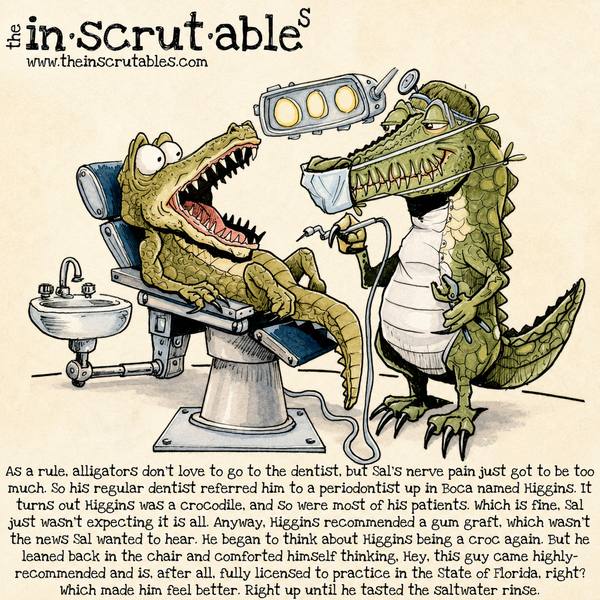
This paper examines the revised state of an Inscrutables panel in which Sal, an alligator with nerve pain, is referred to a periodontist in Boca named Higgins, who turns out to be a crocodile — "and so were most of his patients. Which is fine, Sal just wasn't expecting it is all." The caption, the longest yet catalogued in the canon, narrates Sal's referral, his diagnosis, his private relapse into taxonomic unease, his self-administered consolation ("this guy came highly-recommended and is, after all, fully licensed to practice in the State of Florida, right?"), and his final undoing by a single clinical detail: the taste of the saltwater rinse. The revised ending is analytically superior to its predecessor, because the rinse is not merely an indignity; it is evidence. Crocodiles possess functioning lingual salt glands and tolerate saline environments; alligators, restricted to freshwater, do not. The rinse is therefore the one item in the operatory that is objectively calibrated to the practice's crocodile-native clientele. Sal's anxiety, socially unjustified for nine sentences, is chemically confirmed in the tenth. The paper applies Proximity-Activated Othering (PAO), proposes Narrative Caption Escalation (NCE) as the structural opposite of Captionless Visual Surplus, and reports SPII-2 = 82.7/100 (re-scored), Pun Cascade Density (PCD) = 9.5/10, and Professional Otherness Discount (POD) = 8.8/10.
1. A Specimen Under Revision
Working Papers Nos. 43–48 analyzed stable specimens. The present paper does not. Between the print editions and this deposit, the artist revised the caption itself: the consolation by licensure is new, and the former ending — in which Sal merely had to gargle with saltwater — has been recut so that Sal tastes the rinse, and the story stops on the taste.
The Institute considered treating the revision as a threat to validity. It has elected instead to treat it as data. A canon whose primary texts continue to improve after publication is a canon that takes its own afterlife seriously, which is, after all, the discipline's founding observation (WP43, WP44). The scores below therefore supersede the print figures, and the print editions are retained in the physical archive as witnesses to an earlier caption.
2. The Referral Network
The panel's world is medically complete. Sal has a regular dentist; the regular dentist has a referral network; the network reaches "up in Boca"; the specialist has a name, a specialty, a patient base, and a treatment recommendation. Periodontics is a real referral pathway for nerve pain and gum grafting is a real periodontal procedure, which is precisely why the caption's administrative realism lands. Nothing about the medical system is exaggerated. Only the patients are.
This is the panel's quiet application of the canon's procedural instincts (compare WP45's hiring process and WP47's location policy): the joke is not that reptiles have teeth, but that reptile dentistry has infrastructure.
3. Proximity-Activated Othering, Reapplied
Working Paper No. 49's print edition proposed Proximity-Activated Othering: humor from characters who are structurally similar but invest disproportionate meaning in a comparatively small categorical distinction. The revised caption strengthens the reading. Sal and Higgins share kingdom, phylum, class, and order; they diverge at family. Yet the narrator must interrupt himself to manage the disclosure: "Which is fine, Sal just wasn't expecting it is all."
That defensive clause is the caption's moral center. It is the sentence of a narrator who has noticed what the story is revealing about its protagonist and would like the record to show that everyone involved is fine. The panel thus preserves the structural analogy to human systems of prejudice — enormous commonality coexisting with intense attention to narrow markers of difference — while keeping the accusation deniable. Sal never says anything. He only thinks about Higgins being a croc again, which is somehow worse.
4. The Licensing Consolation
The revision's major addition is Sal's self-soothing appeal to credentials: highly recommended, and fully licensed to practice in the State of Florida.
The Institute notes three layers. First, this is the classic maneuver by which anxious patients convert social discomfort into procedural trust — credentialism as a sedative (compare the credential literature on patient–physician concordance and trust). Second, the jurisdiction is load-bearing: South Florida is the one region in the United States — indeed, essentially the world — where alligators and American crocodiles naturally coexist. A Florida license is the only license that could plausibly govern them both. The consolation is therefore technically sound, which is the funniest thing a consolation can be. Third, "right?" — the appeal ends in a question mark. The sedative is self-administered and the patient can taste the dosage.
5. The Saltwater Rinse as Terminal Evidence
The recut ending converts the rinse from complaint to discovery. Crocodiles possess functioning lingual salt glands and famously tolerate — in some species, commute through — saline water. Alligators do not; they are freshwater animals whose salt-excreting equipment is, at best, vestigial. A saltwater rinse in a periodontal practice is clinically ordinary. A saltwater rinse stocked at crocodile-native salinity is something else: it is the one detail in the operatory objectively calibrated to the clientele Sal was trying not to think about.
For nine sentences, Sal's unease is socially unjustified and the narrator polices it accordingly. In the tenth, chemistry files a brief on Sal's behalf. The panel's cruelty — and its honesty — is that it never adjudicates. Higgins remains credentialed, recommended, and presumably excellent. The rinse remains salty. Sal remains an alligator. The reader is left holding the case file.
6. Canon Principle: Narrative Caption Escalation
The panel establishes Narrative Caption Escalation (NCE): a mode in which the caption abandons the single spoken line for paragraph-scale narration that escalates past every natural stopping point, so that the story's refusal to stop becomes part of the joke.
The caption offers at least four clean exits — the referral, the disclosure, the diagnosis, the consolation — and declines each. NCE is the structural opposite of Captionless Visual Surplus (WP48): where CVS withholds language and lets the image overflow, NCE overproduces language until the narration itself acquires comic mass. The canon's poles are now mapped. Most panels live between a sign that says TOP HATS and a paragraph that will not leave Boca.
7. Metrics
Pun Cascade Density (PCD), introduced in the print editions and formalized here, measures the sustained load of taxonomically and clinically coherent wordplay per caption: Boca, croc, gum graft, nerve pain, and the rinse yield PCD = 9.5/10. Professional Otherness Discount (POD) — the degree to which professional credentials are mobilized to discount a felt social difference — holds at 8.8/10; the licensing consolation is the purest specimen of the mechanism yet catalogued.
The re-scored SPII-2 sub-scores are: Ontological Uncertainty 1.2; Caption–Image Displacement 9.3; Residual Nonresolution 9.5; Pragmatic Polysemy 9.4; Intertextual Dependency 9.5; Narrative Excess 9.9. Weighted result: SPII-2 = 82.7/100 (print: 82.3; the uptick is attributable entirely to the recut ending). Classification: Professionally Credentialed, Taxonomically Proximate, Socially Othered.
8. Conclusion
The revised panel is the canon's most complete fusion of medical realism, taxonomic comedy, and social observation. Its narrator manages a disclosure; its patient manages an anxiety; its jurisdiction manages two species; and its rinse, in four words, undoes all three layers of management at once.
Final SPII-2: 82.7/100 · PCD: 9.5/10 · POD: 8.8/10. The clinical recommendation of the print edition stands and is hereby made canonical: evaluate the periodontist by the quality of the graft, not the width of the snout. The Institute adds one procedural note for the practice in Boca: offer a freshwater option, and label the cooler.
Notes
- On lingual salt glands in crocodiles, see L. E. Taplin and G. C. Grigg, "Salt Glands in the Tongue of the Estuarine Crocodile Crocodylus porosus," Science 212 (1981): 1045–1047. Alligatorids lack comparably functional lingual salt glands and are correspondingly restricted to fresh water; see Grigg and Kirshner, Biology and Evolution of Crocodylians (2015).
- South Florida is the only region where Alligator mississippiensis and the American crocodile (Crocodylus acutus) naturally coexist; see Florida Fish and Wildlife Conservation Commission species accounts. The caption's choice of jurisdiction is therefore not decorative.
- On credentials, concordance, and patient trust, see L. A. Cooper et al., "Patient-Centered Communication, Ratings of Care, and Concordance of Patient and Physician Race," Annals of Internal Medicine 139 (2003): 907–915. The analogy remains structural, not literal; the Institute repeats the print edition's caution that findings concerning species should not be construed as clinical diagnoses.
- On long-form joke architecture and the comic value of narration that refuses to stop, see Jan Harold Brunvand, "A Classification for Shaggy Dog Stories," Journal of American Folklore 76 (1963): 42–68. The present caption is not a shaggy dog story, but they are visibly related, possibly at the family level.
- NCE joins PCAP, BRFT, AMP, PPO, CVS, PAO, and BCR in the canon taxonomy. The Institute notes with satisfaction that Working Paper No. 48 predicted this paper's subject, and with unease that the specimen then changed.
- The Institute is not admitted to practice law, medicine, or dentistry in any jurisdiction, including Florida, where the licensing situation is evidently complicated enough already.
References
Brunvand, Jan Harold. "A Classification for Shaggy Dog Stories." Journal of American Folklore 76 (1963): 42–68. — Cooper, Lisa A., et al. "Patient-Centered Communication, Ratings of Care, and Concordance of Patient and Physician Race." Annals of Internal Medicine 139 (2003): 907–915. — Florida Fish and Wildlife Conservation Commission. Species accounts: American alligator; American crocodile. — Grigg, Gordon, and David Kirshner. Biology and Evolution of Crocodylians. Ithaca: Cornell University Press, 2015. — Integrated Taxonomic Information System. Alligator mississippiensis; Crocodylidae. — Taplin, L. E., and G. C. Grigg. "Salt Glands in the Tongue of the Estuarine Crocodile Crocodylus porosus." Science 212 (1981): 1045–1047. — The Institute for Advanced Studies in Single Panel Comics. Working Papers Nos. 43–48. Macguffin Co., 2026. — Trope, Arthur. The Inscrutables. Comic panel, primary text (revised state).
Revision History
v1.0 — Original print deposit, under the title "The Worst Part Was He Had to Gargle With Saltwater." v2.0 — Print Revised Edition; taxonomic-bias analysis incorporated, PAO proposed, SPII-2 82.3; cover corrections adopted as the series template. v3.0 — Web Deposit; the PRIMARY TEXT was revised by the artist (a licensing consolation added; the ending recut to "tasted the saltwater rinse"), and the paper is rewritten against the revised specimen. SPII-2 re-scored to 82.7. Proposes Narrative Caption Escalation (NCE). The first working paper drafted under the Institute's current editorial arrangement.
Related Institute Research
- Working Paper No. 43 — You Wash While I Dry
- Working Paper No. 44 — So You'd Like Us to Believe There Was a Duck
- Working Paper No. 45 — Our Last Village Idiot Was Promoted to Town Buffoon
- Working Paper No. 46 — We Had to Carry Our Bikes on Our Shoulders
- Working Paper No. 47 — I'm Going to Work from the Boat Today
- Working Paper No. 48 — Top Hats
Citation
The Institute for Advanced Studies in Single Panel Comics. 2026. “Right Up Until He Tasted the Saltwater Rinse.” Working Paper Series, no. 49. Macguffin Co.
@techreport{iasspc_wp049,
  title       = {Right Up Until He Tasted the Saltwater Rinse},
  author      = {{The Institute for Advanced Studies in Single Panel Comics}},
  institution = {Macguffin Co.},
  type        = {Working Paper},
  number      = {49},
  year        = {2026},
  note        = {Archive record IASSPC-WP-049}
}