Working Paper No. 46
We Had to Carry Our Bikes on Our Shoulders
Anachronism, Generational Hardship, and the Prehistoric Logic of Parental Complaint
| Archive record | IASSPC-WP-046 |
|---|---|
| Primary comic | Arthur Trope, The Inscrutables — held in the Trope Collection |
| Series | Working Paper Series · Macguffin Co. · 2026 |
| Status | Deposited Version 1.0 |
Series Continuity Note. The Institute treats these working papers as a cumulative critical apparatus. Stable terms introduced in prior papers may be reused, revised, or challenged when later panels expose stronger formulations.
Abstract
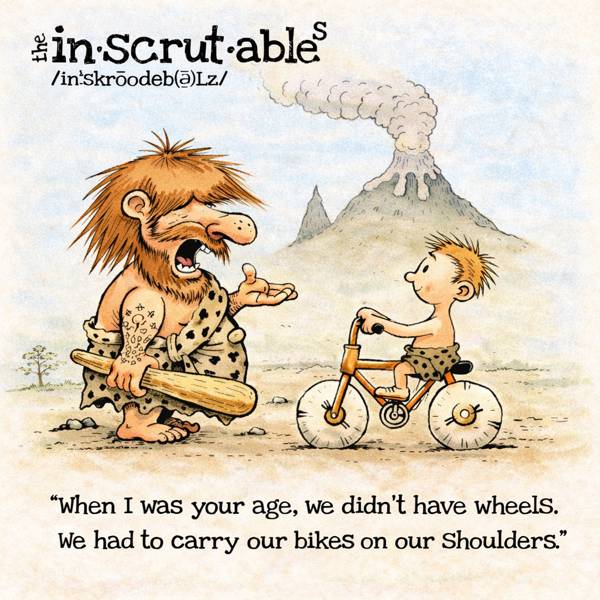
This paper examines an Inscrutables panel in which a caveman elder admonishes a child riding a primitive bicycle: "When I was your age, we didn't have wheels. We had to carry our bikes on our shoulders." The comic fuses intergenerational complaint, the moralization of hardship, and an impossible technological chronology in which bicycles somehow predate wheels. It is therefore not simply a Stone Age joke but a satire of nostalgic self-mythology, in which historical coherence becomes negotiable when remembered deprivation is useful. The standardized SPII-2 score is 71.4/100, classified as Temporally Dislocated, Nostalgically Overbuilt. A supplementary Nostalgic Hardship Inflation Index (NHII) of 9.1/10 records the extraordinary degree to which the speaker inflates ancestral inconvenience in order to convert age into moral authority.
1. Introduction: The Oldest Speech in the World
The phrase "When I was your age" may be among the most durable technologies of authority. The speaker invokes a harsher past, treats survival of that past as a credential, and converts remembered inconvenience into a judgment on present ease. The details change across generations; the argumentative skeleton does not.
Trope's panel activates that script and then breaks history to sustain it. The elder claims that his generation lacked wheels but still possessed bicycles. The statement is impossible, yet immediately intelligible because the social rhetoric is more familiar than the technological logic. The viewer understands the complaint before noticing that the past required for it could not have existed.
2. Impossible Progress
The panel superimposes two timelines: the cultural timeline of parental complaint and the technological timeline of prehistory. Animal skins, a club, rough terrain, and an erupting volcano establish a generalized Stone Age. The child's bicycle, complete with stone-like wheels, introduces a modern form into that setting. The elder then imagines an earlier stage in which bicycles existed before their defining component.
The normal dependency — wheel first, bicycle much later — is conceptually reversed. Yet the line preserves just enough practical structure to remain legible. We know what it means to carry a bike when it cannot be ridden, even though a wheel-less bicycle is barely a bicycle at all. This is functional anachronism: an impossible chronology that retains enough ordinary action to carry the joke.
3. Generational Complaint as Moral Technology
The elder is not neutrally reminiscing. The phrase carries an implied conclusion: therefore you have it easier than we did. Fred Davis's sociology of nostalgia is useful here because nostalgia is not merely passive memory; it can organize identity and establish evaluative contrast between past and present. Trope exaggerates that process until memory itself becomes technologically impossible.
The hardship claim overrides the factual claim. The elder does not need the past to be accurate; he needs it to be worse. This is the panel's psychological truth. Anyone who has heard stories of walking to school uphill both ways will recognize the mechanism even if no volcano was involved.
4. The Wheel and the Bike
The absurdity is sharpened by the cultural importance of the wheel. Richard Bulliet's history of wheeled technology emphasizes how inventions and reinventions of the wheel enabled entire systems of transport, while histories of the bicycle show a much later and more composite device dependent on wheels, frames, steering, materials, and road systems. The joke needs none of this detail, but it benefits from the common-sense dependency: no wheel, no bike.
The child's apparent patience is also important. He does not challenge the claim. He seems to have learned that ancestral hardship stories are not propositions to be falsified but rituals to be survived.
5. Nostalgic Hardship Inflation Index (NHII)
The Institute introduces the Nostalgic Hardship Inflation Index (NHII) to measure the degree to which remembered deprivation is expanded or mythologized for present moral leverage.
The panel receives 2.0 for hardship intensity, 2.0 for anachronistic distortion, 1.9 for moralizing use of memory, 2.0 for progress inversion, and 1.2 for compression efficiency, yielding NHII = 9.1/10. The score is high because one sentence rewrites technological development while preserving the perfectly familiar tone of a parental lecture.
6. SPII-2 Assessment
The standardized metrics are: Ontological Uncertainty 0.8; Caption–Image Displacement 7.1; Residual Nonresolution 6.9; Pragmatic Polysemy 8.3; Intertextual Dependency 7.7; Narrative Excess 7.0. The weighted result is SPII-2 = 71.4/100.
The classification is Temporally Dislocated, Nostalgically Overbuilt. We understand the scene immediately, yet the world implied by the line is systemically impossible. Were there wheel-less bikes? Were they manufactured as burdens? Was carrying them considered transport? The panel wisely refuses to repair its own history.
7. Canon Principle: Anachronistic Moralization of Progress
The panel supports a recurring series structure that the Institute labels Anachronistic Moralization of Progress (AMP): a familiar modern moral or social script is projected into an impossible historical setting, exposing the script by making its assumptions temporally absurd.
Unlike the Post-Canonical Afterlife Principle or Bureaucratic Reification of Folk Types, AMP is driven by temporal displacement. The complaint is recognizable because its social function is stable even when its historical content is nonsense.
8. Conclusion
Trope takes the ancient social script of "When I was your age" and relocates it to a prehistoric world in which bicycles already exist, wheels allegedly do not, and hardship has become valuable enough to override technological dependence. The result is at once a caveman joke, a family joke, and a satire of the moral vanity attached to remembered deprivation.
Final SPII-2: 71.4/100 · NHII: 9.1/10 · Classification: Temporally Dislocated, Nostalgically Overbuilt. Generational recommendation: before invoking the superiority of your youth, verify that its infrastructure could plausibly support your anecdote.
Notes
- Fred Davis, Yearning for Yesterday: A Sociology of Nostalgia (New York: Free Press, 1979). Davis treats nostalgia as a selective reconstruction that can support identity, continuity, and contrast between past and present.
- Richard W. Bulliet, The Wheel: Inventions and Reinventions (New York: Columbia University Press, 2016); David V. Herlihy, Bicycle: The History (New Haven: Yale University Press, 2004). Neither work records a pre-wheel bicycle period.
- The NHII is not validated for use in family disputes, although its conceptual domain overlaps strongly with holiday dinner conversation.
- AMP joins PCAP and BRFT as a stable cross-paper label in the Institute's accumulating canon taxonomy.
References
Bulliet, Richard W. The Wheel: Inventions and Reinventions. New York: Columbia University Press, 2016. — Davis, Fred. Yearning for Yesterday: A Sociology of Nostalgia. New York: Free Press, 1979. — Herlihy, David V. Bicycle: The History. New Haven: Yale University Press, 2004. — The Institute for Advanced Studies in Single Panel Comics. Working Papers Nos. 43–45. Macguffin Co., 2026. — Trope, Arthur. The Inscrutables. Comic panel, primary text.
Revision History
v1.0 — Original deposit. Proposes Anachronistic Moralization of Progress (AMP).
Related Institute Research
Citation
The Institute for Advanced Studies in Single Panel Comics. 2026. “We Had to Carry Our Bikes on Our Shoulders.” Working Paper Series, no. 46. Macguffin Co.
@techreport{iasspc_wp046,
  title       = {We Had to Carry Our Bikes on Our Shoulders},
  author      = {{The Institute for Advanced Studies in Single Panel Comics}},
  institution = {Macguffin Co.},
  type        = {Working Paper},
  number      = {46},
  year        = {2026},
  note        = {Archive record IASSPC-WP-046}
}