Working Paper No. 48
Top Hats
Captionless Commerce, Aquatic Aspiration, and the Semiotics of Cetacean Formalwear
| Archive record | IASSPC-WP-048 |
|---|---|
| Primary comic | Arthur Trope, The Inscrutables — held in the Trope Collection |
| Series | Working Paper Series · Macguffin Co. · 2026 |
| Status | Deposited Version 1.0 |
Series Continuity Note. The Institute treats these working papers as a cumulative critical apparatus. Stable terms introduced in prior papers may be reused, revised, or challenged when later panels expose stronger formulations.
Abstract
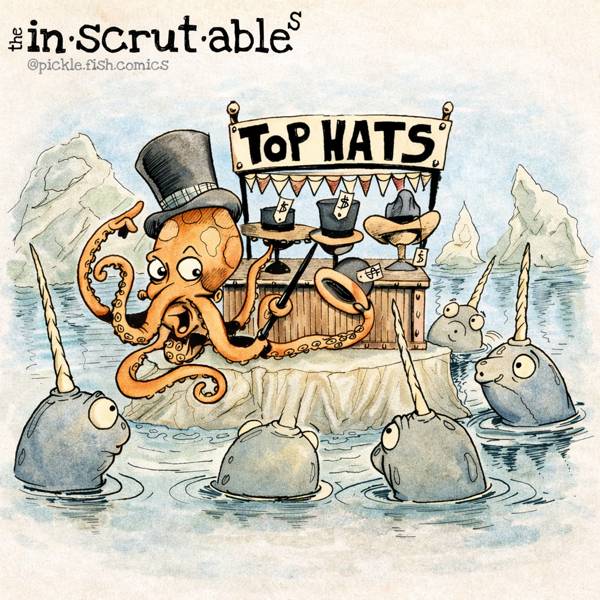
This paper examines a captionless Inscrutables panel in which an octopus operates a market stall labeled TOP HATS while surrounded by narwhals in icy water. With no dialogue and no conventional caption, the burden of humor shifts almost entirely onto visual incongruity, consumer ritual, and the strange dignity of species-inappropriate fashion. The top hat is one of the most overdetermined signs of ceremonial respectability, while the narwhal presents a facial architecture that makes conventional hat-wearing difficult to the point of satire. The octopus serves as an ideal retail intermediary: dexterous, demonstrative, and apparently committed to a highly specific vertical market. The panel receives SPII-2 = 78.2/100, classified as Silently Legible, Commercially Surreal, Morphologically Challenged. A Formalwear Improbability Quotient (FIQ) of 9.3/10 quantifies the mismatch between symbolic intensity of the product and anatomical compatibility of the consumer.
1. Introduction: The Silent Panel as Challenge
The first interpretive fact is that the panel does not speak. Unlike the interrogation, the village job interview, or the Viking's remote-work announcement, this image offers no dialogue and no explanatory sentence. Its only linguistic content is a sign: TOP HATS.
Roland Barthes famously described linguistic content in images as a form of anchorage: words can direct the viewer toward one reading among many. Trope supplies the minimum possible anchor. We know what is being sold, but not why this market exists, whether it succeeds, or how its clientele intends to use the product. The absence of a caption therefore produces not interpretive emptiness but visual surplus.
2. Why Top Hats?
A top hat is not merely headwear. It is historically overcoded: formal, ceremonial, status-conscious, theatrical, and faintly ridiculous even before marine mammals enter the frame. Thorstein Veblen's account of conspicuous consumption is useful because the top hat's social value can easily exceed its practical utility. Georg Simmel's classic essay on fashion likewise treats fashion as a system of imitation and differentiation.
This makes the top hat an ideal comic commodity. Socks would be useful. A top hat arrives carrying class aspiration. The product does not simply clothe; it elevates.
3. Why Narwhals?
The narwhal is already a creature of visual improbability, famous for the long spiral tusk that has encouraged the popular title "unicorn of the sea." For millinery, the tusk is an architectural problem. A conventional top hat assumes a manageable cranial surface. The narwhal presents a projection that invites perforation, balancing, redesign, or heroic disregard for fit.
The gathered customers imply demand despite incompatibility. That is the commercial core of the joke: desire persists where product design verges on mockery. The panel is therefore less about animals wearing clothes than about consumer aspiration surviving obvious constraints.
4. Why an Octopus?
The octopus is perhaps the ideal vendor for this market. Multiple limbs permit display, handling, gesturing, and simultaneous customer attention. Popular culture also grants the octopus intelligence, dexterity, and a faint aura of clever opportunism. Trope turns those traits into retail competence.
The stall itself resembles a pop-up. The octopus has identified an underserved niche: formalwear for narwhals. This is either visionary entrepreneurship or predatory market segmentation. The panel leaves both interpretations open.
5. The Sign as Minimal Caption
The sign performs four jobs at once: title, product category, explanatory anchor, and practical punch line. Without it, the image might be pure surrealism. With it, the scene becomes commercial. The viewer is not facing nonsense but inventory.
This is the crucial formal distinction. A spoken caption tells us how someone in the world interprets the scene. A sign tells us what kind of world we have entered. This is a world in which a narwhal might reasonably be shopping for a top hat.
6. Formalwear Improbability Quotient (FIQ)
The Formalwear Improbability Quotient (FIQ) measures comic friction when a fashion object of high symbolic specificity is offered to a consumer whose body or environment makes the object difficult or unnecessary. Symbolic density scores 2.0; morphological incompatibility 2.0; consumer plausibility 1.7; retail seriousness 1.8; and accessory-driven absurdity 1.8. Total: FIQ = 9.3/10.
The score is high because the world itself is calm. The display is orderly. The customers are attentive. Nothing in the panel treats the transaction as absurd except the audience.
7. SPII-2 Assessment
The standardized sub-scores are Ontological Uncertainty 1.2; Caption–Image Displacement 9.4; Residual Nonresolution 8.6; Pragmatic Polysemy 8.4; Intertextual Dependency 6.7; Narrative Excess 8.1. Weighted result: SPII-2 = 78.2/100.
Classification: Silently Legible, Commercially Surreal, Morphologically Challenged. The creatures are clear, the product is clear, and the transaction is clear. The more we understand, however, the more questions remain about fit, status, trend adoption, and whether the stall offers horn-compatible customization.
8. Canon Principle: Captionless Visual Surplus
The panel establishes Captionless Visual Surplus (CVS): a mode in which an Inscrutables panel withholds a verbal punch line and allows composition, species choice, objects, and minimal signage to generate a self-sustaining excess of meaning.
CVS is especially useful as a series category because it marks a structural opposite to the verbose narrative caption examined in the next working paper. The image does not lack a caption; it outgrows one.
9. Fashion, Status, and the Horn Problem
Pierre Bourdieu's account of taste and distinction is suggestive here: objects need not be useful in order to be socially meaningful. Indeed, their impracticality may intensify status. If a narwhal can wear a top hat despite being a narwhal, the achievement exceeds ordinary fashion. It is formalwear against nature itself.
The tusk therefore functions as both obstacle and opportunity. It makes the product ridiculous while making the act of consumption more expressive.
10. Conclusion
Trope constructs an image in which an octopus sells top hats to narwhals and then wisely refrains from explaining further. The silence is not an omission. It is the condition of the joke's abundance.
Final SPII-2: 78.2/100 · FIQ: 9.3/10 · Classification: Silently Legible, Commercially Surreal, Morphologically Challenged. Retail recommendation: introduce a reinforced crown-slit option before the holiday season.
Notes
- Roland Barthes, "Rhetoric of the Image," in Image–Music–Text, trans. Stephen Heath (New York: Hill and Wang, 1977), 32–51. The concept of anchorage is unusually apt when the only words in the panel are the store sign.
- Thorstein Veblen, The Theory of the Leisure Class (1899). The top hat is almost aggressively Veblenian: ceremonial, impractical, and socially overdetermined.
- Georg Simmel, "Fashion," International Quarterly 10 (1904): 130–155.
- The FIQ has not yet been applied to bow ties, monocles, spats, or cummerbunds in marine environments. This is a regrettable but correctable gap.
- CVS joins PCAP, BRFT, AMP, and PPO in the Institute's canon-wide vocabulary.
- Pierre Bourdieu, Distinction: A Social Critique of the Judgement of Taste, trans. Richard Nice (Cambridge, MA: Harvard University Press, 1984). Bourdieu says very little about cetacean formalwear, but the general mechanism travels well.
References
Barthes, Roland. "Rhetoric of the Image." In Image–Music–Text. Translated by Stephen Heath. New York: Hill and Wang, 1977. — Bourdieu, Pierre. Distinction: A Social Critique of the Judgement of Taste. Cambridge, MA: Harvard University Press, 1984. — Simmel, Georg. "Fashion." International Quarterly 10 (1904): 130–155. — Veblen, Thorstein. The Theory of the Leisure Class. 1899. — The Institute for Advanced Studies in Single Panel Comics. Working Papers Nos. 43–47. Macguffin Co., 2026. — Trope, Arthur. The Inscrutables. Comic panel, primary text.
Revision History
v1.0 — Original deposit. Proposes Captionless Visual Surplus (CVS).
Related Institute Research
- Working Paper No. 43 — You Wash While I Dry
- Working Paper No. 44 — So You'd Like Us to Believe There Was a Duck
- Working Paper No. 45 — Our Last Village Idiot Was Promoted to Town Buffoon
- Working Paper No. 46 — We Had to Carry Our Bikes on Our Shoulders
- Working Paper No. 47 — I'm Going to Work from the Boat Today
Citation
The Institute for Advanced Studies in Single Panel Comics. 2026. “Top Hats.” Working Paper Series, no. 48. Macguffin Co.
@techreport{iasspc_wp048,
  title       = {Top Hats},
  author      = {{The Institute for Advanced Studies in Single Panel Comics}},
  institution = {Macguffin Co.},
  type        = {Working Paper},
  number      = {48},
  year        = {2026},
  note        = {Archive record IASSPC-WP-048}
}