Working Paper No. 51
Thirty-Five Dog Years Together
Canine Chronometry, Anniversary Arithmetic, and the Founding of Somatic Ritual Recalibration
| Archive record | IASSPC-WP-051 |
|---|---|
| Primary comic | Arthur Trope, The Inscrutables — held in the Trope Collection |
| Series | Working Paper Series · Macguffin Co. · 2026 |
| Status | Deposited Version 1.0 |
Series Continuity Note. With this paper the Working Paper Series enters its second volume and its approved publication programme. The Institute reminds readers that stable terms introduced in prior papers may be reused, revised, or challenged, and that the Editorial Calendar is available from the Registrar, who remains otherwise unavailable.
Abstract
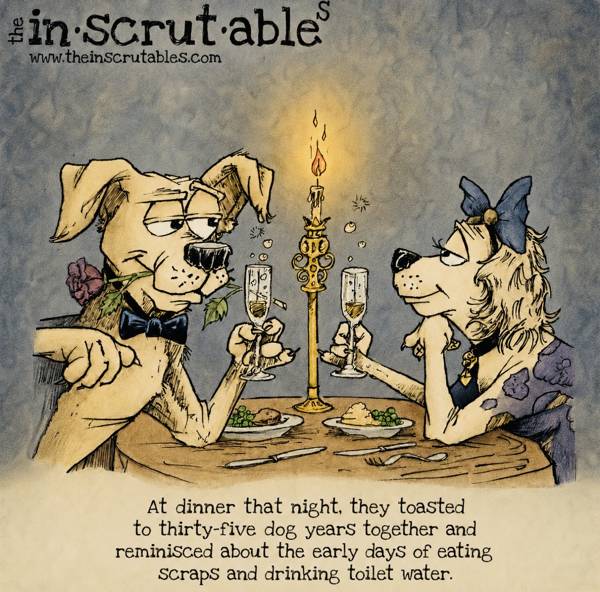
This paper examines an Inscrutables panel in which two dogs share a candlelit anniversary dinner beneath the caption: "At dinner that night, they toasted to thirty-five dog years together and reminisced about the early days of eating scraps and drinking toilet water." The panel executes the full liturgy of the long-married anniversary — dinner, wine, toast, and the ceremonial remembering of humble beginnings — while substituting canine content at exactly two points: the unit of time and the content of the humility. Under the folk convention of seven dog years to one human year, the couple is celebrating five calendar years as thirty-five, a recalibration the panel treats with complete solemnity. The paper argues that this operation exemplifies the canon's largest previously unnamed joke engine, here founded as Somatic Ritual Recalibration (SRR): a panel derives humor by letting a species' true — or truly believed — biology recalibrate the terms of a familiar human ritual it is observing. A supplementary Ritual Recalibration Ratio (RRR) of 7.0× records the temporal rescaling factor. The panel scores SPII-2 = 70.8/100, classified as Chronometrically Recalibrated, Domestically Tender, Retroactively Humble.
1. Introduction: The Anniversary as Imported Technology
The anniversary dinner is among the most standardized rituals available to a couple: a table, candles, wine, a toast to a number, and a supervised visit to the past. Trope's panel imports the ritual into canine life intact. Nothing about the staging is parodied. The dogs sit upright; the candles are lit; the toast is offered with evident feeling.
The joke enters through the number. Thirty-five dog years is the ritual's arithmetic conducted in the celebrants' own units. The couple has not adapted the anniversary to dog life; they have adapted time itself, and the ritual has accepted the amendment without comment. This is the paper's founding observation: the ritual survives translation perfectly, and the translation is the joke.
2. The Arithmetic of Devotion
Under the folk convention — seven dog years to one human year, a ratio of uncertain origin usually traced to mid-twentieth-century veterinary pamphlets — thirty-five dog years resolves to five calendar years of marriage. Five years is a respectable anniversary. Thirty-five is an achievement. The couple has selected the unit that honors the relationship most, which is, the Institute notes, exactly what humans do when they count a marriage in "years together" rather than in arguments survived.
Contemporary canine chronometry complicates the toast further. The methylome-based conversion of Wang and colleagues replaces the linear ratio with a logarithmic curve, under which dog time runs fastest in youth and slows with age. Applied here, the couple's marriage cannot be assigned a stable length at all: its early years were longer than its recent ones. The Institute finds this result scientifically inconvenient and emotionally exact.
3. The Reminiscence: Scraps and Toilet Water
The caption's second movement is the ceremonial remembering of humble beginnings — "the early days of eating scraps and drinking toilet water." This is the standard prosperity narrative of the long marriage (the tiny apartment, the terrible car, the furniture from the street), executed with canine props.
The content is important. Scraps and toilet water are not deprivations in dog terms; by most available evidence dogs regard both as amenities. The nostalgia is therefore doubly recalibrated: the couple has imported not only the human ritual of remembering hardship but the human conviction that the past must have been harder. Compare Working Paper No. 46, where hardship memory is inflated for moral leverage; here it is inflated for tenderness. The mechanism is the same and the interest rate is lower.
4. Canon Principle: Somatic Ritual Recalibration
The panel founds the canon's tenth principle. Somatic Ritual Recalibration (SRR): an Inscrutables panel derives humor by letting a species' true — or truly believed — biology (lifespan, memory, metabolism, anatomy, neurology) recalibrate the terms of a familiar human ritual it is observing, while the ritual's form is preserved with complete fidelity.
SRR names what may be the canon's largest single engine. The Trope Collection already holds an entire cluster awaiting analysis under it: the mayfly whose hundredth birthday is a hundred days; the sea turtle's two hundred and forty-seventh; the goldfish whose declaration "I've been thinking about you" must be read against the folk conviction of a three-second memory (scheduled as Working Paper No. 53); the mosquitoes ordering doubles against a short life expectancy; the jellyfish whose panic attack is contradicted by the absence of a central nervous system. In every case the ritual — birthday, courtship, happy hour, therapy — is performed correctly, and the biology quietly re-prices it.
Two boundary notes. First, SRR requires only that the biology be believed: the goldfish memory convention is experimentally false, and the principle runs on it anyway, because folk biology is the biology rituals are conducted in. Second, the radioactive proposal of the halflives specimen recalibrates a courtship by physics rather than physiology; whether SRR extends to nuclear chemistry is hereby referred to the forthcoming Open Questions page, where it will keep the freewifi problem company.
5. The Ritual Recalibration Ratio (RRR)
The Institute introduces the Ritual Recalibration Ratio (RRR): the factor by which a ritual's temporal or material frame is rescaled by the celebrant species' biology, as accepted within the panel. The present panel's frame is rescaled by the folk conversion, yielding RRR = 7.0×.
The Institute is aware that this is the second instrument in the series to return exactly 7.0 (compare the Causal Inflation Ratio of Working Paper No. 44). The number seven now appears to be doing a great deal of work in this canon. A file has been opened.
6. SPII-2 Assessment
The standardized sub-scores are: Ontological Uncertainty 1.0; Caption–Image Displacement 7.8; Residual Nonresolution 7.2; Pragmatic Polysemy 8.6; Intertextual Dependency 9.2; Narrative Excess 7.9. Weighted result: SPII-2 = 70.8/100.
Ontological Uncertainty is minimal: these are dogs, at dinner. Intertextual Dependency is the panel's ceiling score, because the entire joke rests on the reader's fluency in the dog-year convention; a reader without it sees only a long marriage and two unusually composed dogs. Residual questions are gentle but durable: who officiated; what the wine is; whether the restaurant knows; and what, at a dog anniversary, one orders that is not scraps.
7. Conclusion
The panel is the canon's most affectionate demonstration of its newest principle. Nothing is mocked. The ritual is honored, the units are native, and the past is remembered as harder than it was because that is what pasts are for. Five years or thirty-five, the toast is the same length.
Final SPII-2: 70.8/100 · RRR: 7.0× · Classification: Chronometrically Recalibrated, Domestically Tender, Retroactively Humble. Anniversary recommendation: count in whichever unit makes the number larger, and let the record show the toilet water was cold.
Notes
- On the logarithmic dog-to-human conversion, see Tina Wang et al., "Quantitative Translation of Dog-to-Human Aging by Conserved Remodeling of the DNA Methylome," Cell Systems 11 (2020): 176–185. The folk 7:1 ratio survives in ritual use precisely because it is linear, memorable, and flattering.
- On the social organization of commemorative time — anniversaries as scheduled remembering — see Eviatar Zerubavel, Hidden Rhythms: Schedules and Calendars in Social Life (Chicago: University of Chicago Press, 1981).
- The goldfish memory convention is experimentally false; goldfish learn and retain over months, as the memory-consolidation literature has shown since Agranoff's work in the 1960s. SRR is unbothered: the principle runs on the biology rituals are conducted in, not the biology fish are conducted in.
- The recurrence of 7.0 across CIR (WP44) and RRR (WP51) has been noted, logged, and assigned to no one.
- Working Paper No. 53 (goldfish) is scheduled as SRR's second confirmation per the Editorial Calendar. The Institute is aware that citing its own calendar as forthcoming evidence is circular, and considers this a strength of the calendar.
References
Agranoff, Bernard W., and Roger E. Davis. Studies of memory consolidation in the goldfish, 1960s, various. — Trope, Arthur. The Inscrutables. Comic panel, primary text. — Wang, Tina, et al. "Quantitative Translation of Dog-to-Human Aging by Conserved Remodeling of the DNA Methylome." Cell Systems 11 (2020): 176–185. — Zerubavel, Eviatar. Hidden Rhythms: Schedules and Calendars in Social Life. Chicago: University of Chicago Press, 1981. — The Institute for Advanced Studies in Single Panel Comics. Working Papers Nos. 43–50. Macguffin Co., 2026.
Revision History
v1.0 — Original deposit. Founds Somatic Ritual Recalibration (SRR), the canon's tenth principle, and opens the Institute's file on the number seven. First paper of the approved Editorial Calendar (Volume II programme).
Related Institute Research
Citation
The Institute for Advanced Studies in Single Panel Comics. 2026. “Thirty-Five Dog Years Together.” Working Paper Series, no. 51. Macguffin Co.
@techreport{iasspc_wp051,
  title       = {Thirty-Five Dog Years Together},
  author      = {{The Institute for Advanced Studies in Single Panel Comics}},
  institution = {Macguffin Co.},
  type        = {Working Paper},
  number      = {51},
  year        = {2026},
  note        = {Archive record IASSPC-WP-051}
}